Copyright vs Trademark vs Patent: Protect Your Business
Posted By : Saumya Srivastava | 12-Aug-2025
Do you run a business or a startup? And do you want to make sure your ideas, brand, and creations stay yours? If the answer is yes, then there's no doubt about it: understanding IP Protection rights (Intellectual Property Rights) is a must. Think of your brand, your ideas, and your unique creations as your business's superpowers. Isn't it like it, so precious and a testament of your pure hard work, time and efforts. But, without the right shield, anyone could take them. In today's fast-moving digital world, strong IP protection is your best defense, keeping your content, inventions, and brand identity safe from being copied or misused. According to the World Intellectual Property Organization (WIPO), the global IP filings reached 16.5 million trademark applications and 3.5 million patent applications in 2023. It underscores the importance businesses place on securing their intellectual assets. And that, many business owners already know this. Yet, many business owners remain unclear about the differences between copyright vs trademark vs patent , often leaving valuable assets vulnerable.
Your brand, innovative ideas, and unique creations is truly like a goldmine of your company. Therefore, this blog guide provides a clear, fact-backed words to help you understand which type of IP protection is right for your business, why it matters, and how to implement it effectively.
Understanding Intellectual Property Rights in Business
Intellectual property refers to creations of the mind such as inventions, designs, written works, and brand identifiers. These intangible assets often represent a large portion of a company's value. According to the Ocean Tomo 2020 study, intangible assets now account for 90% of the S&P 500's market value, highlighting the business-critical nature of IP management.
While copyrights, trademarks, and patents are all IP rights, they each protect different aspects of a business's work. Choosing the right one ensures you are legally covered and can take action against infringement.
What is Copyright?
Defintion: Copyright protects original works of authorship including literary, artistic, musical, and certain intellectual works from being copied or used without permission. A copyright protects the expression of an idea, not the idea itself. In software, this applies to the code and the user interface. It grants the creator the exclusive right to reproduce, distribute, and display the work.
Key Features of Copyright
- Covers: Books, music, software code, photographs, blogs, videos.
- Ownership: Automatically granted upon creation, but registration provides stronger legal standing.
- Duration: Typically life of the author plus 60 years (varies by country).
- Rights Granted: Reproduction, distribution, adaptation, public display.
Example:
1. If your business produces a custom software application, copyright ensures that your competitors cannot replicate or distribute the code without your consent.
2. The specific code written for a new accounting software is protected by copyright. If another company copies that code, it is a copyright infringement. The unique arrangement and layout of the software's user interface (UI) is also protected.
Want to read about? Intellectual Property Protection for Source Code | A Developer's Guide
What is a Trademark?
Definition: A trademark protects brand identifiers such as names, logos, and slogans that differentiate your goods or services from competitors. A trademark protects brand identifiers such as a name, logo, or slogan. It distinguishes the goods and services of one company from those of others.
Key Features of Trademark
- Covers: Brand names, logos, taglines, product packaging.
- Ownership: Granted upon registration with the relevant authority (e.g., USPTO, EUIPO).
- Duration: Renewable every 10 years indefinitely.
- Rights Granted: Exclusive use of the mark in your industry to prevent brand confusion.
Example:
- The Starbucks logo and the name "Starbucks" are protected trademarks that reinforce its global brand recognition.
- The name of the accounting software (e.g., "Financially Yours") and its logo are protected by a trademark. This prevents other businesses from using a similar name or logo that could confuse customers into thinking the products are from the same company.
What is a Patent?
Definition: A patent protects new inventions and innovations, giving the inventor exclusive rights to produce, use, and sell the invention for a fixed period. It protects new and non-obvious inventions. This includes a new process, machine, or a method. For software, patents often cover the functionality or algorithm that makes the software innovative.
Key Features of Patent
- Covers: Inventions, processes, designs, machines, chemical compositions.
- Ownership: Granted after a formal application and examination process.
- Duration: Usually 20 years from the filing date.
- Rights Granted: Prevent others from making, using, or selling the invention without permission.
Example:
1. Dyson's cyclone vacuum technology is patented, preventing other companies from copying its unique design and mechanism.
2. A new, efficient algorithm that processes financial data in a unique way within the accounting software could be patented. This prevents other companies from using the same method, even if they write their own code for it.
You may also like | Why Every Business Needs Strong IP Protection
Copyright vs Trademark vs Patent: Core Differences
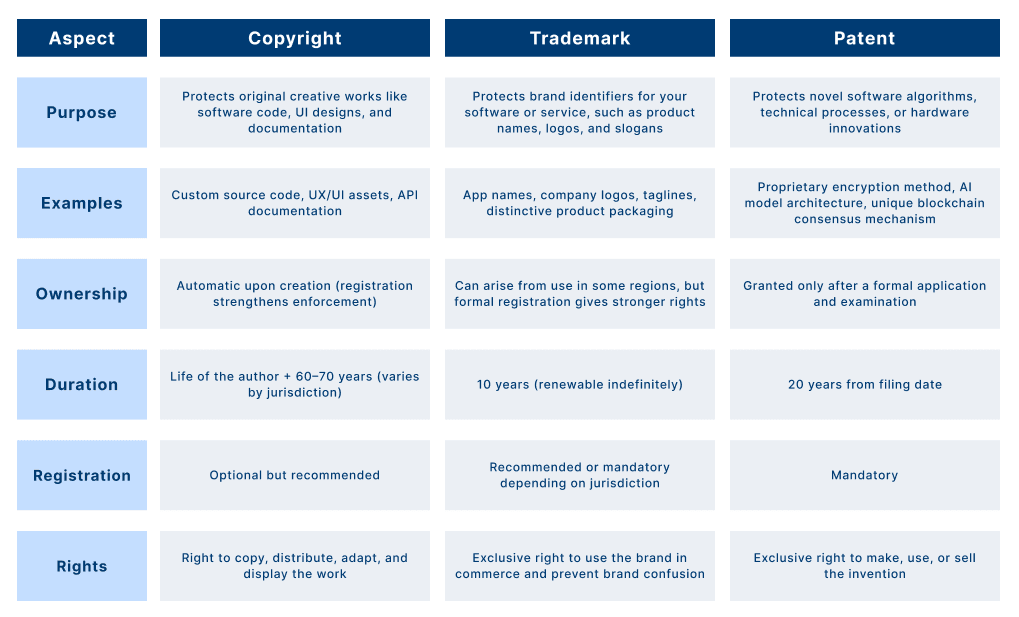
Copyright vs Trademark vs Patent explained for businesses, protect your ideas, brand, and innovations with the right form of legal IP protection rights. Under their differences well with below infographic.
When Should a Business Use Each?
- Use Copyright for original content such as marketing materials, website content, software code, or product designs.
- Use Trademark to protect your brand identity in the marketplace.
- Use Patent to safeguard a unique product, technology, or process that provides a competitive advantage.
Read Also | Basic Types of Intellectual Property Rights
Common Misconceptions About Copyright vs Trademark vs Patent
- One type of IP protection covers everything
Each form of protection serves a distinct purpose. Businesses often need a combination of protections. - Registration is optional for all IP rights
Copyright may be automatic, but trademark and patent protections require formal registration. - Patents last forever
Patents have a set lifespan, after which the invention enters the public domain.
The Cost of Not Protecting Your IP
Failing to secure your intellectual property rights can have serious consequences for your business. It can result in brand dilution and a loss of market recognition, making it harder to stand out from competitors. Unauthorized use or reproduction of your work can erode your revenue streams, while stolen innovations can give rivals an unfair competitive advantage. In many cases, the absence of proper protection leads to costly legal disputes that drain valuable time, money, and resources, hindering business growth and innovation.
Intellectual property (IP) is one of the most valuable assets for any business, but protecting it requires more than just technical safeguards. Legal agreements play a crucial role in ensuring that ownership, usage rights, and confidentiality of IP are clearly defined and enforceable. By combining IP protection strategies with well-drafted agreements such as NDAs, IP rights contracts, and non-compete clauses, businesses can secure their innovations against misuse and establish a strong foundation for trust and compliance.
Watch full video on Legal agreement.*
Frequently Asked Questions
Q1. Can a product have all three types of protections?
Yes. A product can have copyright for its creative content, a trademark for its brand name, and a patent for its invention.
Q2. What is the main difference between Copyright vs Trademark vs Patent?
Copyright protects creative works, trademark secures brand identifiers, and patent safeguards inventions. Think of it as protecting your art, your brand, and your innovations, each with its own rules and benefits.
Q3. How long does a patent take to secure?
It can take 1 to 3 years depending on jurisdiction and complexity.
Q4. What are the 4 types of intellectual property?
The four main types are patents, trademarks, copyrights, and trade secrets, protecting inventions, brand identities, creative works, and confidential business information.
Q5. Can trademark rights be lost?
Yes, if the mark is not used or the registration is not renewed.
Conclusion
Understanding the distinctions between Copyright vs Trademark vs Patent ensures you apply the right protection for your assets. With the right IP protection, you can prevent unauthorized use, protect your market share, and strengthen your brand's credibility. It's not just about legal security, it's about protecting your reputation, your hard work, and your future.
So, take a moment to look at what makes your business special and make sure it's protected. Because in business, the smartest move isn't just creating something amazing-it's keeping it yours.
Secure Your IP
At Oodles, we help businesses safeguard their intellectual property through airtight legal agreements, strategic IP consulting, and technology-driven protection measures. Whether you need copyright registration, trademark enforcement, or patent guidance, our experts ensure your innovations remain protected.
Contact us now and secure your business assets today.


Cookies are important to the proper functioning of a site. To improve your experience, we use cookies to remember log-in details and provide secure log-in, collect statistics to optimize site functionality, and deliver content tailored to your interests. Click Agree and Proceed to accept cookies and go directly to the site or click on View Cookie Settings to see detailed descriptions of the types of cookies and choose whether to accept certain cookies while on the site.















About Author
Saumya Srivastava
Saumya leverages her remarkable expertise as a Content Writer, supported by a deep reservoir of knowledge in the domain. With her extensive background in content writing, Saumya assumes the role of a content strategist with exceptional aptitude. Within this role, she crafts captivating social media posts and thoroughly researched blog entries, both instrumental in shaping a distinctive brand identity. Through seamless collaboration with her team, she amplifies her cooperative skills to drive client growth and advancement effectively.