An insight to Content Delivery Network
Posted By : Oodles Admin | 29-Apr-2015
Conversion Rate and ROI Booster - Content Delivery Network
Looking out for a help to overcome the very known fact i.e, content transportation through WAN takes much longer than LAN (Distance matters). Thus leading to slow Response time Communication (RTC)(Streaming Video/Audio) due to more load on the server. The website takes much more time in loading content than expected, delay in streaming video’s/audio’s which can be due to any of the reason - high bandwidth or more access to same content over a time. So, here is resolution provided by the Oodles ie the use of Content delivery Network (CDN). We at Oodles write/ create applications which can be either generic or specific to serve the world wide content using the particular CDN.
Why do we need a CDN?
When a user tries to access a website, they are first redirected to host’s server which is located at the central location. So, every user on your website is trying to access the server in order to access your website. Now, if the traffic volume is high, overloading increases over the server, which leads to slow content loading over the website. In such scenario, CDN comes into the picture which is discussed in upcoming content.
How does a CDN help?
CDN is a huge distributed web server system deployed in many geographic locations across many different data center.
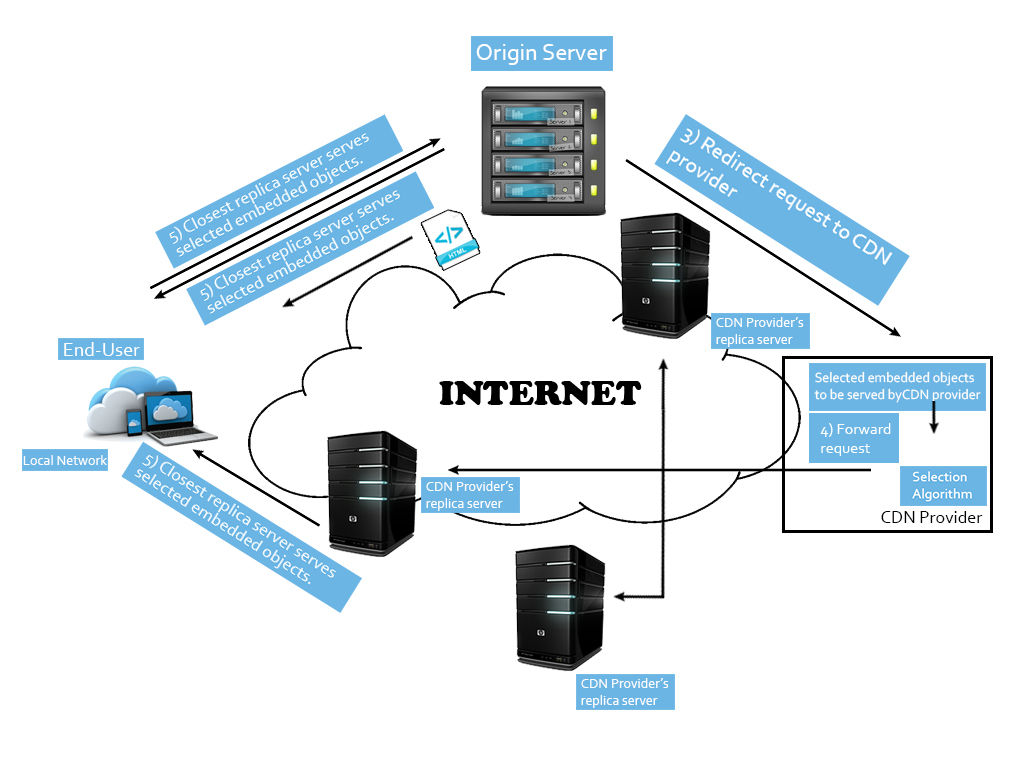
If a website visitor or application user request for certain files ( images, pdf, video’s etc), instead of hosting server, the CDN takes care of responding them with these request. As, a CDN takes user’s geographic location, the file will be served from the user’s nearest caching - node. CDN, acts as an archive, since it copies content over various server (Edge Node). It provides data to the user by calculating the nearest server. Hence, data becomes available with a lightning speed.
If the visitor’s nearest caching node, doesn’t have the requested object, it will ask other nearest node in the CDN first. If object is missing in the CDN, then object will be requested from the Original Server.
Why it is done?
-
To perform transparent and effective content delivery
-
Improve accessibility and maximize the bandwidth
-
To eliminate new expensive routing server and hardware
-
Increase website speed and performance
-
Off-loads your web site and application server load
-
Faster response and latency time
-
Easily handles at peak times
-
Improves SEO and user experience
CDN Business Model -
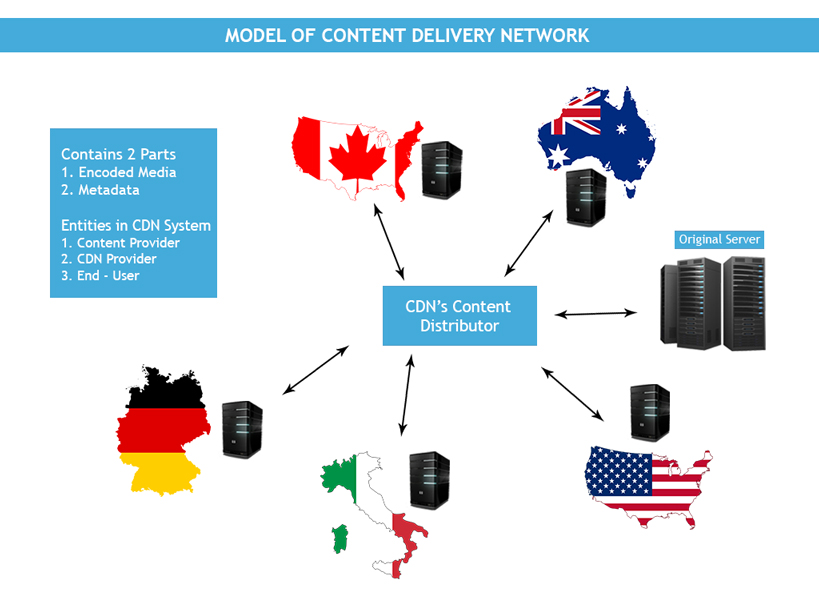
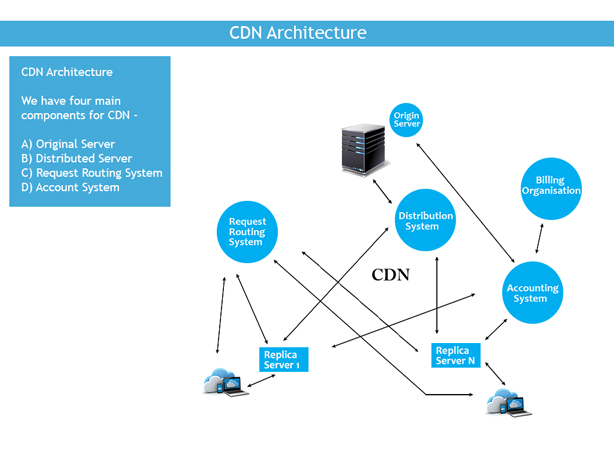
Architectural CDN -
Routing request in CDN -
Factor affecting revenue generation -
-
Cost of bandwidth
-
Size of replicated content over surrogate server
-
Number of surrogate server
-
Traffic Distribution
-
System’s reliability and system stability
Services offered by CDN -
-
Content management and storage
-
Content distribution over edge server
-
Cache management
-
Backup and disaster recovery solutions
-
Performance and monitoring


Cookies are important to the proper functioning of a site. To improve your experience, we use cookies to remember log-in details and provide secure log-in, collect statistics to optimize site functionality, and deliver content tailored to your interests. Click Agree and Proceed to accept cookies and go directly to the site or click on View Cookie Settings to see detailed descriptions of the types of cookies and choose whether to accept certain cookies while on the site.














About Author
Oodles Admin
Divya has more than 6 years of industrial experience in different domains – SAP EP, Search Quality Operations and Content Writing. She loves travelling across the world and also enjoys watching movies.